As Nature inBlended®

Antarctic Krill Oil
Share
Antarctic Krill Oil: What is it and How Does it Compare with Fish Oil?
An evidence-based guide to EPA, DHA, phospholipids, astaxanthin and omega-3 nutrition
Antarctic krill oil is a marine oil obtained from tiny shrimp-like crustaceans called krill. It is a source of the long-chain omega-3 fatty acids EPA (eicosapentaenoic acid) and DHA (docosahexaenoic acid), which are also found in oily fish and fish oil supplements.
Krill oil is often promoted as a premium alternative to fish oil because its omega-3 fatty acids are largely present in phospholipid forms and it naturally contains the red-orange carotenoid astaxanthin. But does this make it better, and what should customers look for when choosing a supplement?
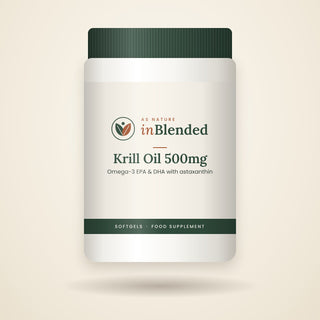
As Nature inBlended's Antarctic Krill Oil is a 500mg capsule. The listed ingredients are krill oil (Euphausia superba) extract, bovine gelatin, glycerol and water. These details matter because 500mg of krill oil is not the same as 500mg of omega-3.
What is Antarctic Krill?
Krill are small marine crustaceans that live in large swarms in the Southern Ocean around Antarctica. They form an important part of the marine food web and are eaten by animals including whales, seals, penguins and fish.
Krill oil is extracted from these tiny crustaceans. Its nutritional interest comes mainly from its omega-3 fatty acids, especially EPA and DHA. It also contains phospholipids and naturally occurring astaxanthin, although the quantities vary between products.
What Are EPA and DHA?
EPA and DHA are long-chain omega-3 polyunsaturated fatty acids. They are important components of cell membranes and are involved in normal cell signalling and other biological processes.
EPA and DHA are found naturally in oily fish such as salmon, sardines, mackerel, herring and trout. They are also available in fish oil, krill oil and some algae-derived supplements.
The body can make small amounts of EPA and DHA from alpha-linolenic acid (ALA), an omega-3 found in foods such as flaxseed, chia seeds, walnuts and rapeseed oil. However, conversion is limited, particularly for DHA, so direct dietary sources can be useful.
Why Are Omega-3 Fats Important?
Omega-3 fatty acids are part of a balanced diet. The European and UK-authorised nutrition claims for EPA and DHA include the following, provided the relevant daily intake conditions are met:
- EPA and DHA contribute to the normal function of the heart when the combined daily intake is 250mg.
- DHA contributes to the maintenance of normal brain function at a daily intake of 250mg.
- DHA contributes to the maintenance of normal vision at a daily intake of 250mg.
- DHA and EPA contribute to the maintenance of normal blood triglyceride levels at a daily intake of 2g, when taken in combination with EPA.
- DHA and EPA contribute to the maintenance of normal blood pressure at a daily intake of 3g. The claim has additional conditions, including that supplemental intake should not exceed 5g per day.
These are specific authorised nutrient-function claims. They do not mean that every krill oil capsule supplies these amounts, or that taking a supplement will prevent or treat heart disease, high blood pressure, high triglycerides, dementia or eye disease.
What Makes Krill Oil Different from Fish Oil?
The main difference is the form in which some of the fats are carried.
In krill oil, a substantial proportion of EPA and DHA is present in phospholipids. Phospholipids are important components of cell membranes and have both water-attracting and fat-attracting parts. In fish oil, EPA and DHA are generally present mainly as triglycerides or, in some products, ethyl esters.
This difference has led to the suggestion that krill oil may be absorbed more efficiently. Comparisons are difficult because products differ in their EPA and DHA content, chemical forms, doses and study methods.
For a fair comparison, customers should look at the actual EPA and DHA amounts per daily serving, not simply the total milligrams of oil in the capsule.
What is Astaxanthin?
Astaxanthin is a naturally occurring red-orange carotenoid pigment. It is found in certain algae and accumulates in marine organisms, including krill, through the food chain.
Astaxanthin has antioxidant activity in laboratory studies.
Can Krill Oil Support Heart Health?
EPA and DHA have recognised roles in normal heart function when consumed at the authorised daily intake of 250mg combined. This is a nutrient-function claim, not proof that krill oil supplements prevent cardiovascular disease.
Research into omega-3 supplements and cardiovascular outcomes is more complicated. Studies have used different formulations and doses, and results cannot be transferred automatically from prescription-strength omega-3 medicines to ordinary food supplements.
The NIH Office of Dietary Supplements notes that evidence for benefits from eating seafood is stronger for some health outcomes than evidence for omega-3 supplements. Fish and seafood provide nutrients beyond EPA and DHA, and eating them may also replace less nutritious foods in the diet.
Krill oil should not be used instead of prescribed medicines or medical advice for cholesterol, blood pressure or heart disease.
How Much Omega-3 Does a Krill Oil Capsule Provide?
This is one of the most important questions to ask.
A capsule described as 500mg krill oil contains 500mg of the oil, not necessarily 500mg of EPA and DHA. The actual EPA and DHA content will be lower and varies according to the raw material and formulation.
Who Might Consider a Krill Oil Supplement?
Adults who do not regularly eat oily fish may look at marine omega-3 supplements as one way of increasing their EPA and DHA intake. However, a supplement is not essential for everyone, and dietary needs vary.
The NHS recommends that people aim to eat at least two portions of fish a week, including one portion of oily fish. Examples include salmon, mackerel, sardines, trout and herring. People who do not eat fish may wish to consider algae-derived omega-3 products, which can provide DHA and, depending on the formulation, EPA.
Krill oil is derived from a crustacean and is not suitable for vegetarians or vegans.
Safety, Allergies and Medicines
The most important product-specific warning is that krill is a crustacean. As Nature inBlended's ingredient list identifies krill oil (Euphausia superba) and labels it as a crustacean ingredient. Anyone with a shellfish or crustacean allergy should avoid the product unless an allergy specialist has specifically advised otherwise.
Omega-3 supplements can cause mild digestive effects in some people, such as an unpleasant aftertaste, heartburn, nausea or loose stools.
People taking anticoagulant or antiplatelet medicines, those with a bleeding disorder, and anyone preparing for surgery should discuss omega-3 supplements with their doctor or pharmacist. The effect depends on the dose and individual circumstances; do not stop prescribed medication or change treatment without medical advice.
People who are pregnant or breastfeeding, have a medical condition or take regular medication should seek professional advice before starting a supplement. The product uses a bovine gelatin capsule, so it is not suitable for people avoiding bovine-derived ingredients.
What About Sustainability?
Krill is a major part of the Antarctic marine ecosystem, so responsible management of harvesting is important. The existence of a regulated fishery does not, by itself, establish that every krill oil product is sustainably sourced.
Customers interested in environmental impact can look for transparent information about the source fishery, traceability, catch limits and independent certification. They can also consider algae-derived omega-3, which is produced without harvesting krill or fish.
The Takeaway
Antarctic krill oil is a source of EPA and DHA omega-3 fatty acids, often carried in phospholipids, and it naturally contains astaxanthin.
The most useful way to compare products is to check the actual EPA and DHA content per daily serving.
As Nature inBlended's Antarctic Krill Oil is listed as a 500mg capsule containing krill oil extract and a bovine gelatin capsule.
Krill oil is not suitable for people with crustacean allergies, and anyone taking medicines that affect blood clotting should seek professional advice before use. Oily fish remains a valuable food source of omega-3 fats, while algae-derived oils provide an alternative for people avoiding marine animal products.
Food supplements should not be used as a substitute for a varied, balanced diet and a healthy lifestyle.
Sources and Further Reading
As Nature inBlended – Antarctic Krill Oil: https://www.asnatureinblended.com/products/antarctic-krill-oil
NIH Office of Dietary Supplements – Omega-3 Fatty Acids: Fact Sheet for Health Professionals: https://ods.od.nih.gov/factsheets/Omega3FattyAcids-HealthProfessional/
US National Center for Complementary and Integrative Health – Omega-3 Supplements: What You Need to Know: https://www.nccih.nih.gov/health/omega3-supplements-what-you-need-to-know
International Society of Sports Nutrition Position Stand: Long-Chain Omega-3 Polyunsaturated Fatty Acids (2024): https://pmc.ncbi.nlm.nih.gov/articles/PMC11737053/
Salem N Jr and Kuratko CN. A reexamination of krill oil bioavailability studies. Lipids in Health and Disease (2014): https://pmc.ncbi.nlm.nih.gov/articles/PMC4161905/
NHS – Fish and shellfish: https://www.nhs.uk/live-well/eat-well/food-types/fish-and-shellfish-nutrition/
In our shop: Antarctic Krill Oil
This article is for general information and education only. It is not medical advice and is not intended to diagnose, treat, cure or prevent any disease. Food supplements should not be used as a substitute for a varied, balanced diet and a healthy lifestyle. Do not exceed the recommended daily intake. If you are pregnant, breastfeeding, taking medication, under medical supervision or have a health condition, speak to your GP or pharmacist before use. Keep out of the reach of children.