As Nature inBlended®

Biotin 10,000µg – What Does High-Dose Biotin Actually Do?
Share
Biotin is a water-soluble B vitamin, also known as vitamin B7. It is an essential nutrient involved in several processes that help the body use food for energy. It is often promoted in supplements for hair, skin and nail health, but the evidence behind taking very large doses is more limited than many people expect.
What is biotin?
Biotin acts as a coenzyme for a small group of enzymes involved in metabolism. These enzymes help the body process fats, carbohydrates and proteins, and take part in pathways used to produce energy and make important biological molecules.
Biotin therefore has genuine, essential functions. However, this does not mean that taking more biotin automatically increases energy, improves metabolism or produces healthier-looking hair and nails. Nutrients help maintain normal body functions; extra amounts do not necessarily create extra benefits when intake is already adequate.
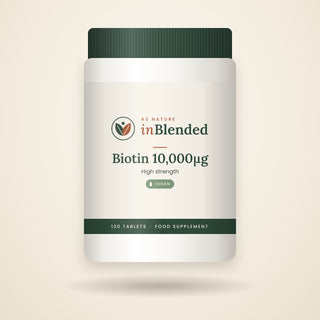
The product featured here provides 10,000µg (10mg) of biotin per tablet. The product label describes this as 20,000% of the Nutrient Reference Value (NRV). The NRV is a food-labelling reference used to compare nutrient amounts; it is not a target that everyone needs to reach through supplements.
Biotin and hair, skin and nails: what does the evidence say?
Biotin deficiency can cause symptoms that include hair thinning or hair loss, a scaly rash and brittle nails. In someone who is genuinely deficient, correcting the deficiency is important.
Biotin deficiency is uncommon in healthy people eating a varied diet. For people who already obtain enough biotin, there is currently little reliable evidence that high-dose supplements improve ordinary hair growth, skin appearance or nail strength.
A small number of studies and case reports have described improvements in particular circumstances, including rare inherited hair-shaft disorders and some cases involving infants with skin problems. These findings cannot be assumed to apply to otherwise healthy adults seeking thicker hair or stronger nails.
Hair changes can have many causes, including iron deficiency, thyroid conditions, hormonal changes, illness, stress, medication and genetic pattern hair loss. Persistent or sudden hair loss is better discussed with a GP or qualified healthcare professional than treated by simply increasing supplement doses.
Biotin and energy metabolism
Biotin contributes to normal energy-yielding metabolism and normal macronutrient metabolism. In practical terms, it helps enzymes carry out reactions involved in processing the food we eat.
There is no good evidence that taking 10mg of biotin gives an otherwise well-nourished person more energy or improves exercise performance.
Foods that contain biotin
Biotin is present in a range of everyday foods. Useful dietary sources include:
- Cooked eggs
- Liver and other organ meats
- Fish
- Meat
- Nuts and seeds
- Sweet potatoes and some other vegetables
A varied diet generally provides biotin. The amount in individual foods can vary, and food-composition data are not equally complete for every item.
Biotin is also produced by bacteria living in the gut, although the contribution this makes to an individual's overall requirement is not fully established.
How much biotin do adults need?
There is no single UK Reference Nutrient Intake for biotin in the same way there is for some other vitamins. The European food-labelling NRV is 50µg per day. The US National Academies have set an Adequate Intake of 30µg per day for adults; an Adequate Intake is used where evidence is insufficient to establish a formal Recommended Dietary Allowance.
These reference values are a useful reminder of the difference between nutritional amounts and high-dose products. A 10,000µg tablet contains 10mg, which is 200 times the 50µg labelling NRV.
The NHS advises that most people should be able to obtain the biotin they need from a varied, balanced diet. It says that taking 0.9mg (900µg) or less per day in supplements is unlikely to cause harm. The product discussed here provides 10mg, substantially more than that amount.
Why can high-dose biotin affect blood tests?
This is one of the most important safety issues with high-strength biotin supplements.
Some laboratory tests use a technology that relies on the interaction between biotin and a protein called streptavidin. A high amount of biotin circulating in the blood can disrupt certain tests and produce results that are falsely high or falsely low.
Depending on the particular test, this may affect results used to assess thyroid hormones, vitamin D and other markers. Of particular concern, some cardiac blood tests, including certain troponin assays used when investigating a possible heart attack, can be affected.
The effect depends on the laboratory method, the amount of biotin in the blood and the timing of the test. There is no single waiting period that is suitable for every person or every assay.
If you take a high-dose biotin supplement, tell your GP, clinician and the laboratory before having blood tests. Tell them the exact product and dose, and when you last took it. They can decide whether the test method or timing needs to be adjusted. Do not delay urgent medical assessment or stop a prescribed treatment without medical advice.
Is 10,000µg of biotin safe?
No tolerable upper intake level has been established for biotin because available evidence has not been sufficient to identify a level at which adverse effects reliably occur.
The clearest recognised concern at high supplemental intakes is interference with laboratory tests. The NHS also advises caution with high daily doses because the effects are not fully understood.
The product label gives a serving of one tablet daily with water and food. It advises adults not to exceed the recommended serving, and says the product is not recommended for people who are pregnant or breastfeeding. It also advises speaking to a healthcare professional before use, particularly if taking medication or under medical supervision.
Check other supplements before combining them. Biotin may already be present in multivitamins, B-complex products and hair, skin and nail formulas. Taking several products together can increase the total dose without necessarily offering an additional benefit.
Who might need a biotin supplement?
Most healthy adults eating a varied diet are unlikely to need a high-dose biotin supplement. A healthcare professional may recommend biotin in specific situations, such as a confirmed deficiency or a rare inherited condition affecting biotin metabolism.
People with ongoing symptoms should seek advice about possible causes rather than assume that low biotin is responsible. A supplement is not a substitute for investigating unexplained hair loss, skin changes, fatigue or nail problems.
About the As Nature inBlended product
It contains Biotin 10,000µg – 120 Tablets . Each tablet provides 10,000µg (10mg) of biotin, stated as 20,000% NRV. The tablets are suitable for vegetarians and vegans and gives an adult serving of one tablet daily with water and food.
The listed ingredients are dicalcium phosphate and microcrystalline cellulose as bulking agents, D-biotin, and magnesium stearate as an anti-caking agent. The product is manufactured in the UK to GMP standards.
The label also advises that the product is not recommended during pregnancy or breastfeeding and that people taking medication or under medical supervision should consult a healthcare professional before use.
The takeaway
Biotin is an essential nutrient with established roles in normal energy-yielding and macronutrient metabolism, and in maintaining normal hair and skin. However, deficiency is rare, and there is little convincing evidence that taking very high doses improves hair, skin or nails in people who already have enough biotin.
A 10,000µg tablet is a high-dose supplement, not an ordinary nutritional top-up. Its potential to interfere with important blood tests makes it particularly important to tell healthcare professionals and the laboratory that you take it. For many people, a balanced diet is sufficient; if you are concerned about hair, skin or nail changes, finding the underlying cause is a more useful first step than automatically choosing a high-strength supplement.
*Food supplements should not be used as a substitute for a varied, balanced diet and healthy lifestyle. Do not exceed the recommended daily dose. This article is for general education and is not individual medical advice.*
Sources and further reading
- As Nature inBlended – Biotin 10,000µg, 120 Tablets: https://www.asnatureinblended.com/products/biotin-10-000ug-120-tablets
- NHS – Vitamins and minerals: B vitamins and folic acid: https://www.nhs.uk/conditions/vitamins-and-minerals/vitamin-b/
- US National Institutes of Health, Office of Dietary Supplements – Biotin: Health Professional Fact Sheet: https://ods.od.nih.gov/factsheets/Biotin-HealthProfessional/
- US National Institutes of Health, Office of Dietary Supplements – Biotin: Consumer Fact Sheet: https://ods.od.nih.gov/factsheets/biotin-consumer/
- AACC – Guidance Document on Biotin Interference in Laboratory Tests: https://doi.org/10.1093/JALM/JFZ010
This article is for general information and education only. It is not medical advice and is not intended to diagnose, treat, cure or prevent any disease. Food supplements should not be used as a substitute for a varied, balanced diet and a healthy lifestyle. Do not exceed the recommended daily intake. If you are pregnant, breastfeeding, taking medication, under medical supervision or have a health condition, speak to your GP or pharmacist before use. Keep out of the reach of children.