As Nature inBlended®

Brazilian Decaf Coffee: The Swiss Water Process, Caffeine and What to Know
Share
Decaffeinated coffee offers the familiar aroma and ritual of coffee with substantially less caffeine. It can suit people who enjoy coffee but want to reduce their caffeine intake, whether because of sleep, sensitivity to caffeine or personal preference.
This guide explains the process, what “decaf” means in practice and how to interpret research about coffee without making unsupported health claims.
What is Brazilian decaf coffee?
Coffee beans are the seeds of the fruit of Coffea plants. Brazil is one of the world's major coffee-producing countries, and Brazilian coffees can vary considerably according to growing region, variety, processing and roasting.
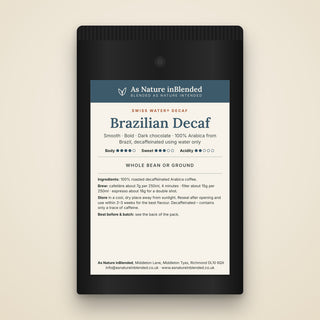
Its Brazilian decaf beans are selected for a smooth, consistent cup, with a full body and notes of dark chocolate. These are tasting descriptions rather than nutritional or medical claims. The exact flavour experienced will also depend on grind size, brewing method, water and personal taste.
Decaffeination takes place before roasting, while the beans are still green. The aim is to remove most of the caffeine while retaining as much of the coffee's flavour compounds as possible.
How does the Swiss Water Process work?
The Swiss Water Process is a water-based decaffeination method. In broad terms, green coffee beans are hydrated and brought into contact with a specially prepared green coffee extract. Caffeine moves out of the beans into the surrounding liquid by diffusion. The liquid is passed through filters designed to remove caffeine, and the process is repeated.
The method uses water, temperature, time and carbon filtration rather than added chemical solvents such as methylene chloride or ethyl acetate. The process is designed to remove caffeine while retaining much of the soluble flavour material that gives coffee its character.
The term “chemical-free” is commonly used in product descriptions to mean that chemical solvents are not used. Strictly speaking, water and coffee themselves are chemicals in the scientific sense. A clearer description is “decaffeinated without chemical solvents”.
Does decaf coffee contain any caffeine?
Yes. Decaffeinated does not mean completely caffeine-free. A small residual amount can remain, and the amount in a prepared cup varies with the beans, serving size and brewing method.
The US Food and Drug Administration gives a typical range of around 2–15 milligrams of caffeine in an eight-fluid-ounce cup of decaf coffee. This is much less than a typical regular coffee, but it may still matter to someone who is extremely sensitive to caffeine or has been advised to avoid it.
If you need to avoid caffeine completely for medical reasons, do not assume decaf is suitable.
Coffee and health: what does the evidence say?
Coffee contains more than caffeine. It also contains chlorogenic acids and other polyphenols, along with small amounts of minerals and other compounds. Research into coffee and health is extensive, but many studies are observational. They can identify associations but cannot always show that coffee itself caused an outcome.
Some large observational studies have found that habitual coffee consumption is associated with lower rates of certain health outcomes. Results may be affected by lifestyle, diet, smoking, preparation method and other factors.
Decaf coffee contains many of the same non-caffeine compounds as regular coffee, although the exact composition can change during processing and roasting. Research on coffee in general does not always distinguish clearly between caffeinated and decaffeinated varieties, so it is not appropriate to assume every reported association applies equally to decaf.
Coffee is best viewed as an optional drink that can fit into a balanced diet, not as a treatment or supplement.
Is decaf better for sleep or caffeine sensitivity?
Reducing caffeine can help people who experience jitters, palpitations, anxiety-like symptoms or difficulty sleeping after drinking regular coffee. Caffeine's effects vary between individuals, and the timing of consumption matters because caffeine can remain in the body for several hours.
Switching to decaf may reduce exposure considerably, especially if someone previously drank several cups of regular coffee. However, residual caffeine means it may not eliminate symptoms in people who are particularly sensitive. If sleep is a concern, consider the total caffeine consumed throughout the day, including tea, cola, energy drinks, chocolate and some medicines.
Persistent palpitations, significant anxiety or ongoing sleep problems should be discussed with a healthcare professional rather than managed only by changing coffee.
Decaf coffee and pregnancy
The NHS advises that pregnant women should have no more than 200 milligrams of caffeine per day from all sources. Decaffeinated coffee can help reduce caffeine intake, but it still contributes a small amount. Count all sources of caffeine rather than treating decaf as completely caffeine-free.
People who are pregnant or breastfeeding and have individual concerns should follow advice from their midwife, GP or pharmacist.
Acidity, digestion and other considerations
Decaf coffee is not necessarily low-acid. Both caffeinated and decaffeinated coffee can cause heartburn, reflux or stomach discomfort in some people. Responses differ, and roast level, brewing style, serving size and what the coffee is consumed with may all influence tolerance.
Coffee can also stimulate bowel movements in some people. Decaffeination may reduce some caffeine-related effects, but it does not guarantee that the drink will be comfortable for everyone.
If coffee repeatedly causes troublesome symptoms, reducing the amount, changing the brewing method or avoiding it may be more useful than relying on a “decaf” label alone.
How to prepare Brazilian decaf coffee
Use the brewing method and grind appropriate to the product supplied. For a good starting point:
- Use freshly filtered water where possible.
- Measure coffee consistently so you can adjust strength to taste.
- Use a grind suited to your equipment: coarser for a cafetière, medium for many filter methods and fine for espresso.
- Avoid leaving brewed coffee on a hot plate for a long time, as the flavour can deteriorate.
- Store beans or ground coffee in a cool, dry place in a well-sealed container, away from heat, moisture and strong odours.
There is no need to drink coffee at a particular time or in a particular quantity for health reasons. Choose an amount that suits your taste and tolerance.
Choosing As Nature inBlended Brazilian Decaf Coffee
The website has shown the product in multiple pack sizes. These are size variants of the same coffee and do not require separate educational articles.
The process itself uses water and carbon filtration. Decaffeination does not mean that every trace of caffeine is removed.
The bottom line
Brazilian decaf coffee can offer the taste and routine of coffee with much less caffeine than a regular cup. The Swiss Water Process uses water-based extraction and carbon filtration rather than chemical solvents, and is designed to preserve coffee's flavour while removing most of its caffeine.
Decaf is not completely caffeine-free, and it is not a disease-preventing product. Enjoy it according to your own preferences and tolerance, and seek professional advice if you have been told to avoid caffeine or if coffee causes persistent symptoms.
Further reading and references
- As Nature inBlended – Brazilian Decaf Coffee product listing: https://www.asnatureinblended.com/products/brazilian-decaf-500g
- Swiss Water – The Swiss Water Process: https://www.swisswater.com/pages/coffee-decaffeination-process
- US Food and Drug Administration – Spilling the Beans: How Much Caffeine is Too Much?: https://www.fda.gov/consumers/consumer-updates/spilling-beans-how-much-caffeine-too-much
- NHS – Foods to avoid in pregnancy (caffeine guidance): https://www.nhs.uk/pregnancy/keeping-well/foods-to-avoid/
- World Health Organization – Effects of restricted caffeine intake by mother on fetal, neonatal and pregnancy outcomes: https://www.who.int/tools/elena/review-summaries/caffeine-pregnancy--effects-of-restricted-caffeine-intake-by-mother-on-fetal-neonatal-and-pregnancy-outcomes
- Royal Society of Chemistry – Decaffeination: how does it work?: https://edu.rsc.org/feature/decaffeination-how-does-it-work/4013450.article
Educational information only; not a substitute for individual medical advice.
This article is for general information and education only. It is not medical advice and is not intended to diagnose, treat, cure or prevent any disease. Food supplements should not be used as a substitute for a varied, balanced diet and a healthy lifestyle. Do not exceed the recommended daily intake. If you are pregnant, breastfeeding, taking medication, under medical supervision or have a health condition, speak to your GP or pharmacist before use. Keep out of the reach of children.