As Nature inBlended®

Calming Supplements for Dogs: L-Theanine, Taurine and What the Evidence Shows
Share
Dogs can show signs of fear, stress or anxiety for many reasons. Fireworks, thunderstorms, travel, unfamiliar people, changes in routine and being left alone can all affect behaviour. Owners naturally want to help, and calming supplements are often marketed as a gentle option.
Some supplement ingredients have plausible biological roles and limited research in companion animals. However, evidence for a particular ingredient does not automatically prove that a finished product will treat anxiety, separation-related distress or noise phobia. A supplement should never delay veterinary assessment when a dog is frightened, distressed or showing a sudden change in behaviour.
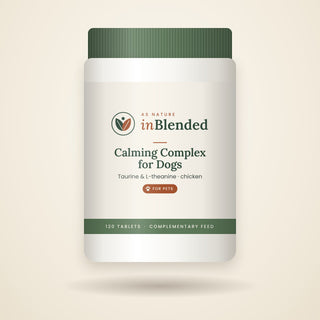
What is in the As Nature inBlended Pet Calming product?
It is a chicken-flavoured supplement for dogs. It lists taurine, inositol, L-theanine, thiamine (vitamin B1), ginger extract and magnesium.
The stated typical amount per tablet is:
- Taurine: 240mg
- Inositol: 240mg
- L-theanine: 15mg
- Thiamine: 6mg
- Ginger extract: 5mg
- Magnesium: 4mg
It gives weight-based serving guidance. Owners should follow the current product label and consult a vet before use if the dog is under medical supervision. Do not increase the amount because a dog appears particularly anxious, and do not combine calming supplements without checking with a veterinary professional.
Understanding canine stress and anxiety
A dog that barks, pants, trembles, hides, paces, destroys objects or urinates indoors may be experiencing fear or distress, but these signs can also have other causes. Pain, illness, age-related changes, noise sensitivity and environmental factors can influence behaviour.
Separation anxiety is not simply a dog being naughty or disobedient. It is a fear-related condition associated with being separated from an attachment figure. Noise aversion can also be severe and may worsen if the dog repeatedly experiences frightening sounds without relief.
A veterinary examination is particularly important if the behaviour is new, escalating, associated with pain or physical symptoms, or involves self-injury or aggression.
L-theanine: what is known?
L-theanine is an amino acid naturally found in tea leaves. It is studied for its effects on aspects of nervous-system activity and relaxation in humans, and it is included in some animal calming products.
There is some research into L-theanine-containing products in dogs, but studies are often small and may investigate multi-ingredient products rather than L-theanine alone. That makes it difficult to establish how much of any observed effect is due to L-theanine itself, what dose is appropriate for a particular dog, or whether results apply to every type of anxiety.
The 15mg amount listed per Pet Calming tablet should therefore be understood as a product formulation detail, not proof of a clinically effective treatment dose.
Taurine: an important amino acid, not a proven anti-anxiety treatment
Taurine is a sulphur-containing compound found in many animal tissues. It has important roles in normal physiology, including bile acid conjugation and functions in the nervous system and other tissues.
Taurine is sometimes discussed in relation to calming because of its involvement in nervous-system biology. There is not enough robust clinical evidence to treat taurine alone as an established canine anxiety therapy.
The product lists 240mg per tablet. Whether additional taurine is appropriate depends on the dog's overall diet, health and veterinary circumstances.
Inositol: biological interest, limited canine evidence
Inositol is a naturally occurring compound involved in cell signalling. It is sometimes marketed in human supplements for mood-related purposes, but evidence from human studies cannot simply be transferred to dogs.
There is not strong clinical evidence that oral inositol supplements reliably treat anxiety or behavioural problems in dogs.
Vitamin B1 (thiamine): essential nutrition
Thiamine is an essential B vitamin involved in carbohydrate metabolism and normal nerve function. Dogs need adequate thiamine in their diet.
A deficiency can cause serious neurological and general health problems, but providing additional thiamine to a dog that already receives enough is not the same as treating anxiety. The Pet Calming product lists 6mg per tablet; owners should consider this alongside the dog's complete diet and any other supplements.
A dog with appetite loss, vomiting, neurological signs or a suspected nutritional deficiency needs veterinary assessment rather than an attempt to self-treat with a calming supplement.
Magnesium: an essential mineral, not a sedative
Magnesium contributes to many normal biological processes, including nerve and muscle function. It is an essential mineral, but there is no sound basis for assuming that extra magnesium will make every anxious dog calmer.
The product lists 4mg per tablet. The amount is small in comparison with the magnesium supplied by a complete diet, and a supplement should not be used to correct a suspected deficiency without veterinary guidance. Excessive supplementation can cause problems, particularly in animals with underlying illness or impaired kidney function.
Ginger extract
Ginger is a plant used in food and traditional remedies. It contains compounds such as gingerols and shogaols, which have been investigated for various biological effects.
Ginger is not an established treatment for canine anxiety. In this product it is listed at 5mg per tablet. Do not assume that evidence relating to nausea or digestive comfort demonstrates a calming effect. Dogs with digestive symptoms or ongoing illness should be assessed by a vet.
Do calming supplements work?
The honest answer is that evidence varies by ingredient and product, and is not strong enough to promise that a supplement will resolve clinically significant anxiety.
A review of current evidence on noise fears in dogs concluded that management and behaviour modification are central to treatment. It found that many alternative remedies, including nutraceuticals and herbal products, are unlikely to be powerful enough as the sole treatment for serious noise fears. For some dogs, veterinary-prescribed medication may be appropriate alongside a behaviour plan.
This distinction matters. A supplement might be considered as an adjunct in an individual case, but it should not replace treatments with stronger evidence or delay help for a dog in distress.
What can owners do to help an anxious dog?
Practical steps depend on the trigger and severity:
- Create a safe place: provide a quiet, comfortable area where the dog can choose to rest.
- Reduce exposure to triggers: close curtains, use background sound during fireworks or storms, and avoid forcing a frightened dog to approach a trigger.
- Use positive associations: where appropriate, pair low-level sounds or situations with food, play or other rewards.
- Build predictable routines: regular exercise, rest, feeding and interaction can help dogs feel secure.
- Plan gradual training: separation-related problems may require carefully structured desensitisation and counterconditioning. Sudden long absences can make the problem worse.
- Seek qualified help: a vet can check for medical causes and advise whether a qualified behaviour professional or medication is needed.
Never punish a dog for fear-related behaviour. Punishment can increase distress and does not address the underlying emotional response.
Safety and when to speak to a vet
Before giving a calming supplement:
- Check the current ingredient list and serving instructions.
- Ask a vet if the dog is pregnant, elderly, unwell, taking medication or under medical supervision.
- Do not combine multiple calming products or human supplements without veterinary advice.
- Stop and contact a vet if an unexpected reaction occurs.
- Keep tablets out of reach of children and other animals.
- Do not use a supplement as a substitute for assessment of severe anxiety, self-injury, aggression or sudden behavioural change.
A dog that is panicking during fireworks, cannot tolerate being left alone, or is injuring itself needs a proper plan. A veterinarian can discuss behavioural management, training and, when appropriate, medication. Behavioural treatment is often gradual and should be tailored to the individual dog.
The bottom line
As Nature inBlended's Pet Calming tablets combine taurine, inositol, L-theanine, thiamine, ginger extract and magnesium.
For mild situational concerns, owners may wish to discuss a supplement with their vet as one possible part of a wider welfare plan. For persistent fear, noise phobia or separation-related distress, veterinary assessment and evidence-based behaviour support are much more important than relying on a tablet alone.
Product information and references
As Nature inBlended – Pet Calming 120 Chicken Flavour Tablets: https://www.asnatureinblended.com/products/pet-calming-120-chicken-flavour-tablets
Scientific and veterinary references:
- Therapy and Prevention of Noise Fears in Dogs – A Review of the Current Evidence for Practitioners (2023): https://pmc.ncbi.nlm.nih.gov/articles/PMC10705068/
- Merck Veterinary Manual – Treatment of Behavior Problems in Animals (reviewed 2024; updated 2025): https://www.merckvetmanual.com/behavior/behavioral-medicine-introduction/treatment-of-behavior-problems-in-animals
- Cornell University College of Veterinary Medicine – Anxious Behavior: How to Help Your Dog Cope with Unsettling Situations: https://www.vet.cornell.edu/departments-centers-and-institutes/riney-canine-health-center/canine-health-information/anxious-behavior-how-help-your-dog-cope-unsettling-situations
- FDA – Approval of tasipimidine for noise aversion and separation anxiety in dogs (6 May 2026): https://www.fda.gov/animal-veterinary/cvm-updates/fda-approves-first-drug-treat-noise-aversion-and-separation-anxiety-dogs
- American Society for the Prevention of Cruelty to Animals – Separation Anxiety: https://www.aspca.org/pet-care/dog-care/common-dog-behavior-issues/separation-anxiety
Educational information only. This article is not a substitute for veterinary advice, diagnosis or treatment.
This article is for general information and education only. It is not medical advice and is not intended to diagnose, treat, cure or prevent any disease. Food supplements should not be used as a substitute for a varied, balanced diet and a healthy lifestyle. Do not exceed the recommended daily intake. If you are pregnant, breastfeeding, taking medication, under medical supervision or have a health condition, speak to your GP or pharmacist before use. Keep out of the reach of children.