As Nature inBlended®

D-Mannose & Cranberry: Ingredients, Evidence and Safety
Share
D-MANNOSE & CRANBERRY: WHAT DOES THE EVIDENCE REALLY SAY? A balanced guide to D-mannose, cranberry, live cultures and urinary tract health
D-mannose is a simple sugar found naturally in small amounts in some fruits. It has become popular as an ingredient in supplements aimed at people who experience recurrent urinary tract infections (UTIs). It is often combined with cranberry, probiotics and minerals.
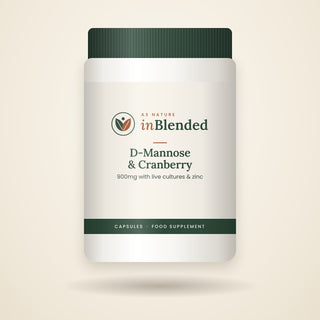
As Nature inBlended's D-Mannose & Cranberry combines D-mannose with cranberry extract, Lactobacillus acidophilus, zinc, cinnamon, oregano and bamboo leaf. 900mg D-mannose per serving, 2,160mg cranberry extract and 2 billion CFU of L. acidophilus.
The important question is not simply whether D-mannose has a plausible mechanism, but whether well-designed human studies show that taking it actually prevents UTIs. The evidence has changed in recent years, and this article reflects that.
What's in each serving
90 capsules per pot. Each serving (2 capsules) provides:
| Ingredient | Amount | %NRV† |
|---|---|---|
| Zinc | 1.5mg | 16% |
| D-Mannose | 900mg | |
| Cranberry* | 2160mg | |
| Bamboo Leaf* | 20mg (providing 15mg silica) | |
| Lactobacillus Acidophilus | 10mg (providing 2 billion CFU) | |
| Ceylon Cinnamon* | 10mg | |
| Oregano Leaf* | 4mg* |
†NRV = Nutrient Reference Value. *Equivalent weight from extract.
Ingredients: D-Mannose Powder, Capsule Shell: Hydroxypropyl Methylcellulose (HPMC), Cranberry Extract (Vaccinium Macrocarpon), Bamboo Leaf Extract (Bambusa Vulgaris), Lactobacillus Acidophilus Powder, Zinc Glycinate, Oregano Leaf Extract (Origanum Vulgare), Ceylon Cinnamon Bark Extract (Cinnamomum Zeylanicum).
How to take: Take 2 capsules, 2 to 3 times per day or as advised, with water or unsweetened cranberry juice.
What is D-Mannose?
D-mannose is a naturally occurring simple sugar, chemically related to glucose. It occurs in small amounts in foods including cranberries, apples and some other fruits. The body also produces and uses mannose as part of normal biological processes.
D-mannose is absorbed after it is eaten and much of it is excreted in urine. Researchers have studied whether it might interfere with the ability of some Escherichia coli (E. coli) bacteria to attach to cells lining the urinary tract. Certain E. coli use hair-like structures called type 1 fimbriae, with a protein called FimH at their tips, to attach to cells. D-mannose may bind to FimH and reduce attachment in laboratory conditions.
This is a biologically plausible idea, but a mechanism seen in laboratory studies does not prove that a supplement prevents infection in real life. Clinical trials are needed to test that.
What Does the Clinical Evidence Show?
Early interest in D-mannose was driven partly by a 2014 trial in non-pregnant women with recurrent UTIs. In that study, participants who took D-mannose had fewer recurrences than those receiving no preventive treatment. The trial helped inform the 2018 NICE guideline, which says some non-pregnant women, and trans men and non-binary people with a female urinary system, who have recurrent UTIs may wish to try D-mannose as a self-care option. NICE also notes that the evidence came from one study; we advise people to consider the sugar content.
However, newer and larger research has made the picture less encouraging.
A large UK primary-care randomised trial published in 2024 tested daily D-mannose against placebo in women with recurrent UTIs. It found no significant reduction in medically attended suspected UTIs, microbiologically confirmed infections or other important outcomes. The NIHR's 2025 evidence summary concluded that D-mannose did not prevent UTIs in this group.
A 2025 systematic review and meta-analysis of randomised trials also found no statistically significant reduction in recurrent UTIs compared with control or antibiotic groups. The authors noted limitations and differences between studies, but the findings do not support confident claims that D-mannose prevents recurrent infection.
The Cochrane review similarly found that available studies were too small and varied to establish whether D-mannose prevents or treats UTIs.
It is not a proven way to prevent UTIs.
Can D-Mannose Treat an Active UTI?
No supplement should be relied on to treat an active urinary tract infection. D-mannose is not an antibiotic and is not a substitute for appropriate medical assessment or prescribed treatment.
Common UTI symptoms include burning or pain when passing urine, needing to urinate more often or urgently, and pain low in the abdomen. Seek advice from a GP or NHS 111 if symptoms suggest a UTI, especially if symptoms are worsening or not improving.
Seek urgent medical advice if there is a high temperature or shivering, pain in the back or side under the ribs, blood in the urine, vomiting, or feeling very unwell, as these can be signs of a kidney infection or more serious illness. People who are pregnant, children, men, and people with certain medical conditions should seek prompt professional advice rather than self-treating.
What About Cranberry?
Cranberry contains plant compounds called proanthocyanidins (PACs). Some research suggests that particular cranberry products may reduce the risk of recurrent UTIs in some groups, possibly by making it harder for certain bacteria to attach to the urinary tract lining.
But cranberry products are not all the same. Juice, whole fruit, powders and extracts can differ considerably in PAC content and dose. A study of one standardised product cannot automatically be applied to another cranberry supplement.
The Cochrane review on cranberry products found evidence of benefit for some groups, including women with recurrent UTIs, but results vary by population and product. Cranberry is not a treatment for an active infection.
What Does the Live Culture Contribute?
The formula also contains Lactobacillus acidophilus, a species of bacteria found in some fermented foods and used in probiotic supplements.
Probiotic effects are strain-specific. Evidence for probiotics in recurrent UTI prevention remains mixed and insufficient to make a reliable claim for this particular formulation.
Why is Zinc Included?
Zinc is an essential mineral. It contributes to the normal function of the immune system and to the protection of cells from oxidative stress. These are authorised nutrient functions when the product contains enough zinc to meet the relevant conditions for the claims.
Zinc is found in meat, shellfish, dairy foods, eggs, beans, nuts and wholegrains.
Cinnamon, oregano and bamboo leaf are also listed. There is not enough product-specific clinical evidence to say that they prevent UTIs.
What Should Customers Check Before Using It?
It would be even more informative if it also stated:
- The exact recommended daily serving and number of capsules.
- The amount of zinc per serving and its percentage of the nutrient reference value.
- The cranberry extract's proanthocyanidin (PAC) content and standardisation.
- The full strain designation for Lactobacillus acidophilus and the CFU guaranteed to the end of shelf life.
- The quantity of cinnamon, oregano and bamboo leaf extracts.
- Clear advice about sugar content and any relevant precautions.
We advise taking the capsule with water and food unless the label says otherwise, and recommends speaking to a GP or pharmacist if pregnant, breastfeeding, taking medication or under medical supervision.
Possible Side Effects and Precautions
D-mannose is a sugar. It may cause digestive effects such as loose stools, bloating or diarrhoea in some people, particularly at higher intakes. Anyone managing diabetes or monitoring carbohydrate intake should consider the product's sugar content and ask a healthcare professional if unsure.
People with kidney disease, those who are pregnant or breastfeeding, and anyone taking regular medication or under medical supervision should seek advice before using a multi-ingredient supplement. Cranberry products may not be appropriate for everyone; people taking warfarin should discuss cranberry use with their anticoagulation service or pharmacist rather than starting it without advice.
The product contains several ingredients, so anyone with allergies or sensitivities should read the complete label carefully.
The Takeaway
D-mannose has a plausible mechanism that has attracted scientific interest, but a plausible mechanism is not proof of benefit. Early research suggested a possible reduction in recurrent UTIs, and NICE's self-care recommendation reflects that earlier evidence. However, a large UK trial published in 2024 found no preventive benefit, and later reviews have also found the evidence inconclusive.
Cranberry may help some people with recurrent UTIs, but effects depend on the product and its PAC content.
As Nature inBlended's formula provides 900mg D-mannose, 2,160mg cranberry extract and 2 billion CFU of Lactobacillus acidophilus per stated serving. Customers would benefit from fuller details on cranberry PAC content, probiotic strain and zinc quantity. Most importantly, the product is not a proven treatment or guaranteed prevention for urinary tract infections.
Anyone with symptoms of an active UTI should seek appropriate medical advice and should not delay assessment or prescribed treatment in favour of a supplement.
Food supplements should not be used as a substitute for a varied, balanced diet and a healthy lifestyle.
Sources and Further Reading
As Nature inBlended – D-Mannose & Cranberry: https://www.asnatureinblended.com/products/d-mannose-and-cranberry
NICE – Urinary tract infection (recurrent): antimicrobial prescribing, recommendations: https://www.nice.org.uk/guidance/ng112/chapter/Recommendations
Hayward G et al. d-Mannose for prevention of recurrent urinary tract infection among women: a randomized clinical trial. JAMA Internal Medicine (2024): https://pubmed.ncbi.nlm.nih.gov/38587819/
NIHR Evidence – D-mannose does not prevent urinary tract infections (6 February 2025): https://evidence.nihr.ac.uk/alert/d-mannose-does-not-prevent-urinary-tract-infections-utis/
Cochrane – D-mannose (sugar tablets) for preventing or treating urinary tract infections in adults and children: https://www.cochrane.org/evidence/CD013608_d-mannose-sugar-tablets-preventing-or-treating-urinary-tract-infections-adults-and-children
Systematic review and meta-analysis of D-mannose for recurrent UTI prevention (2025): https://pubmed.ncbi.nlm.nih.gov/41004704/
NHS – Urinary tract infections (UTIs): https://www.nhs.uk/conditions/urinary-tract-infections-utis/
Related guides
In our shop: D-Mannose & Cranberry
This article is for general information and education only. It is not medical advice and is not intended to diagnose, treat, cure or prevent any disease. Food supplements should not be used as a substitute for a varied, balanced diet and a healthy lifestyle. Do not exceed the recommended daily intake. If you are pregnant, breastfeeding, taking medication, under medical supervision or have a health condition, speak to your GP or pharmacist before use. Keep out of the reach of children.