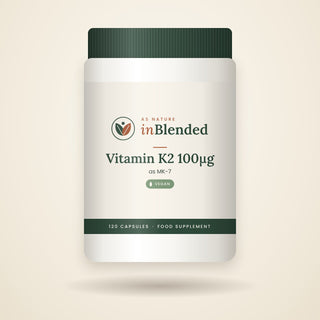
As Nature inBlended®

Vitamin K2 MK-7 100µg: What It Does, Food Sources and What the Evidence Says
Share
Vitamin K is best known for its role in normal blood clotting, but it is also needed to activate proteins involved in bone metabolism. Vitamin K2 is one group within the wider vitamin K family. It has attracted interest in nutritional research, particularly in relation to bone health and the body's regulation of calcium.
This article explains the nutrient and the MK-7 form often used in supplements.
What is vitamin K?
Vitamin K is a fat-soluble vitamin. The two main dietary groups are:
- Vitamin K1 (phylloquinone): found mainly in green leafy vegetables and some vegetable oils.
- Vitamin K2 (menaquinones): a family of related compounds, including MK-4 and MK-7, found in certain animal-derived and fermented foods.
The different menaquinones are identified by the length of their chemical side chain. MK-7 is one of the longer-chain forms and is commonly used in food supplements.
Vitamin K acts as a co-factor for an enzyme that activates several proteins. These include proteins involved in blood clotting and proteins associated with bone metabolism. It is therefore an essential nutrient, not simply a supplement ingredient marketed for bones.
What does vitamin K2 do?
Vitamin K is required for the normal activation of vitamin K-dependent proteins. Two often discussed examples are:
Osteocalcin: A protein produced by bone-forming cells. Vitamin K is needed for its normal activation. Osteocalcin is involved in bone mineralisation, although this biological role does not by itself prove that taking extra K2 prevents osteoporosis or fractures.
Matrix Gla protein (MGP): A vitamin K-dependent protein found in several tissues, including blood vessels. Researchers are investigating its role in regulating tissue calcification. This is an active area of research, but it is not established that K2 supplements prevent arterial calcification or cardiovascular disease.
The authorised UK nutrition claim for vitamin K is that it contributes to the maintenance of normal bones and normal blood clotting.
What is MK-7?
MK-7 stands for menaquinone-7, one form of vitamin K2. It occurs naturally in some fermented foods, particularly natto, a traditional Japanese food made from fermented soybeans.
MK-7 is often selected for supplements because it remains in the circulation for longer than some other forms of vitamin K. However, a longer presence in the blood does not automatically mean that a supplement produces better clinical outcomes. The evidence for health benefits needs to be assessed by looking at human studies, not simply absorption or blood-level measurements.
If a product label specifies MK-7, it should also ideally identify the amount per serving and the source or preparation. Do not assume that every product described simply as “vitamin K2” contains the same form.
Food sources of vitamin K
A varied diet can provide vitamin K from several food groups.
Vitamin K1 sources include:
- Kale, spinach, broccoli and cabbage;
- Brussels sprouts and other green vegetables;
- Some vegetable oils.
Vitamin K2 sources include:
- Natto and some other fermented foods;
- Certain cheeses;
- Eggs, meat and dairy foods, which can contain smaller amounts.
The amount of vitamin K in foods varies with the food, production method and preparation. Green vegetables are particularly useful sources of vitamin K1 and also provide fibre and other nutrients.
For most people, a balanced diet is the first place to meet nutritional needs. A supplement may be considered where there is a specific reason, but it is not a replacement for a varied diet.
How much vitamin K do adults need?
There is no single universally adopted UK reference intake for vitamin K equivalent to the familiar reference values for some other vitamins. The US National Institutes of Health lists adequate intakes of 90µg daily for adult women and 120µg for adult men. These figures are useful context, but they are not UK-specific treatment targets.
A 100µg supplement is therefore a meaningful supplemental amount. It should be considered alongside dietary intake and any other products containing vitamin K, rather than automatically added to a multivitamin or combination supplement.
Vitamin K is fat-soluble, and absorption from food is supported by the presence of dietary fat. Follow the product label for directions and do not take more than the stated serving.
Does vitamin K2 improve bone health?
There is a sound biological reason to study vitamin K and bone: vitamin K is needed to activate osteocalcin, a protein involved in bone metabolism. Some observational studies have linked higher vitamin K intake with better measures of bone health.
Clinical trial findings, however, are mixed. Some studies of vitamin K supplements have reported improvements in selected bone measurements, while others have found no meaningful effect. Trials have used different forms and doses, and some of the research has involved doses of MK-4 that are much higher than the quantities commonly found in retail K2 products.
The US National Institutes of Health concludes that it remains unclear whether vitamin K supplementation reduces the risk of osteoporosis. It is therefore not appropriate to describe a 100µg K2 supplement as a proven way to prevent fractures, reverse osteoporosis or replace prescribed treatment.
For bone health, the wider picture matters: adequate calcium and vitamin D, sufficient protein, weight-bearing activity, avoiding smoking, limiting excess alcohol and addressing falls risk all have important roles. Anyone diagnosed with osteoporosis should follow their clinician's treatment and monitoring advice.
What about heart and artery health?
Vitamin K-dependent proteins such as matrix Gla protein have led to research into whether vitamin K2 might influence calcification in blood vessels. Observational studies have reported associations between dietary menaquinone intake and some cardiovascular outcomes.
Clinical trials have not yet provided convincing evidence that taking K2 prevents heart attacks, strokes or vascular calcification in the general population. More well-designed research is needed.
K2 is not a substitute for established cardiovascular risk reduction, such as stopping smoking, managing blood pressure and cholesterol, being physically active and following prescribed medication.
Vitamin K and warfarin: an important safety warning
Vitamin K can interact seriously with warfarin and other vitamin K-antagonist anticoagulants. These medicines work by blocking vitamin K's role in the clotting process. A sudden increase or decrease in vitamin K intake can alter the effect of the medicine and affect blood-clotting control.
If you take warfarin, do not start, stop or change a vitamin K supplement without speaking to your anticoagulation clinic, GP or pharmacist. The important principle is to keep vitamin K intake consistent and have any changes managed by the team monitoring your treatment.
Do not assume that a supplement is safe simply because vitamin K is a nutrient found in food. The interaction is clinically important.
Other medicines can affect vitamin K status or absorption. Long-term use of certain antibiotics, bile-acid sequestrants and orlistat may be relevant in some circumstances. Ask a pharmacist or clinician if you take regular medication or have a condition affecting fat absorption.
Is vitamin K2 safe?
Vitamin K has a low potential for toxicity, and a tolerable upper intake level has not been established by the US Food and Nutrition Board. This does not mean that every dose or combination is appropriate for every person.
Seek professional advice before using a K2 supplement if you:
- Take warfarin or another vitamin K-antagonist anticoagulant;
- Are under medical supervision or have a condition affecting blood clotting;
- Take several supplements that contain vitamin K;
- Are pregnant or breastfeeding and unsure whether supplementation is appropriate.
People taking direct oral anticoagulants, such as apixaban or rivaroxaban, should not assume the interaction is identical to warfarin. They should still check new supplements with a pharmacist or prescriber rather than changing treatment independently.
Do you need a separate K2 supplement if you take vitamin D?
Vitamin D and vitamin K have different functions. Vitamin D contributes to normal calcium absorption and the maintenance of normal bones. Vitamin K contributes to the maintenance of normal bones and normal blood clotting.
The fact that both nutrients have roles in bone biology does not mean that everyone taking vitamin D also needs a K2 supplement. There is not enough evidence to recommend routine K2 supplementation for every person taking vitamin D, nor to claim that K2 is required to prevent calcium from being deposited in arteries.
Check the contents of combination products carefully. As Nature inBlended also lists products combining vitamin D3 and K2, so taking more than one product could increase your total intake. Follow the label and seek advice if you are unsure whether products overlap.
The As Nature inBlended perspective
At As Nature inBlended, we believe supplements should complement a balanced diet rather than replace it. Vitamin K is an essential nutrient with well-established roles in normal blood clotting and the maintenance of normal bones. Vitamin K2, including MK-7, is an interesting form that continues to be studied.
The evidence does not yet justify presenting K2 supplements as a treatment for osteoporosis or a proven way to protect arteries. People taking warfarin need particular care because changes in vitamin K intake can affect anticoagulant control.
Food supplements should not be used as a substitute for a varied, balanced diet and a healthy lifestyle. Keep supplements out of the reach of children.
Sources and further reading
- As Nature inBlended – Ingredient A–Z, Vitamin K2 100µg listing: https://www.asnatureinblended.com/pages/ingredients
- NIH Office of Dietary Supplements – Vitamin K: Fact Sheet for Health Professionals: https://ods.od.nih.gov/factsheets/VitaminK-HealthProfessional/
- NIH Office of Dietary Supplements – Vitamin K: Fact Sheet for Consumers: https://ods.od.nih.gov/factsheets/VitaminK-Consumer/
- NHS – Warfarin: https://www.nhs.uk/medicines/warfarin/
- NHS – Vitamins and minerals: https://www.nhs.uk/conditions/vitamins-and-minerals/
Product labels and formulations can change. Anyone taking warfarin or another anticoagulant should consult their anticoagulation team or pharmacist before changing vitamin K intake.
Related guides
This article is general educational information, not individual medical advice.
In our shop: Vitamin K2 100µg
This article is for general information and education only. It is not medical advice and is not intended to diagnose, treat, cure or prevent any disease. Food supplements should not be used as a substitute for a varied, balanced diet and a healthy lifestyle. Do not exceed the recommended daily intake. If you are pregnant, breastfeeding, taking medication, under medical supervision or have a health condition, speak to your GP or pharmacist before use. Keep out of the reach of children.