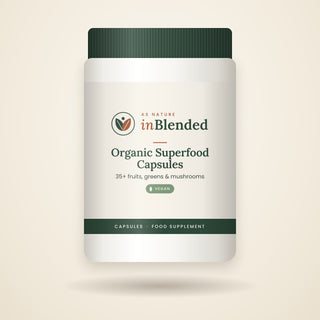
As Nature inBlended®

Organic Superfood Capsules
Share
“Superfood” is a popular description for foods that contain a range of nutrients or plant compounds. It is not a scientific or regulated category, and it does not mean that a product has been shown to deliver exceptional health benefits.
As Nature inBlended's Organic Superfood Capsules combine a wide variety of powdered fruits, vegetables, greens, algae, mushrooms, seeds, grains, herbs and digestive enzymes. This variety may appeal to people who want a convenient way to include several plant ingredients in their routine. But the value of a multi-ingredient supplement depends on more than the number of ingredients: quantities, nutrient levels, quality testing and the overall diet all matter.
What is in the Product?
It is an organic and vegan multi-nutrient blend containing more than 35 organic ingredients, plus a non-organic enzyme blend.
The listed ingredients include:
- Greens and grasses: pre-sprouted activated barley, wheatgrass, barley grass, barley grass juice and wheatgrass juice.
- Fruits and berries: acai, acerola cherry, apple, bilberry, baobab, blueberry, cranberry and lucuma.
- Vegetables and sprouts: broccoli sprout, beetroot, carrot, cauliflower sprout, green cabbage, kale, parsley, spinach and tomato.
- Other plant ingredients: alfalfa, linseed (flaxseed), nettle, quinoa, kelp, turmeric and chlorella.
- Mushrooms and algae: cordyceps, maitake, reishi, shiitake and spirulina.
- Enzymes: protease, amylase, bromelain, cellulase, lactase, papain and lipase.
Why Plant Variety Matters
Fruit, vegetables, pulses, wholegrains, nuts and seeds provide fibre, vitamins, minerals and a broad range of naturally occurring plant compounds. Eating a variety of these foods is associated with good overall dietary quality.
A capsule blend can provide a convenient selection of powdered ingredients, but it is not nutritionally equivalent to eating whole vegetables and fruit. The amount of each ingredient may be small, and capsules do not reproduce the volume, water content, texture or full fibre contribution of a varied diet.
A supplement should complement – not replace – meals built around vegetables, fruit, wholegrains, pulses, nuts and seeds.
Greens, Grasses and Sprouts
The formula includes wheatgrass, barley grass, their juice powders, pre-sprouted barley and several vegetable sprouts.
Green vegetables can contribute folate, vitamin K, carotenoids and other nutrients. However, whether this capsule provides a meaningful amount depends on the quantities used and the finished product's nutritional analysis. Ingredient presence alone is not enough to make a nutrition claim.
It contains both wheatgrass and barley grass, but also explicitly lists wheatgrass powder, pre-sprouted barley powder and barley powder. This is important for anyone avoiding gluten: barley contains gluten, and the product should not be assumed suitable for people with coeliac disease or medically diagnosed gluten sensitivity. People with coeliac disease should check directly with the manufacturer and their healthcare team before using it.
Fruit and Berry Ingredients
Acai, bilberry, blueberry, cranberry, baobab, acerola, apple and lucuma contribute different naturally occurring plant compounds. Acerola is known for its vitamin C content, while berries contain polyphenols and other pigments.
Nor does it prove that the blend will improve circulation, vision, immunity, urinary health or skin.
For example, bilberry is often promoted for eyesight, but evidence that bilberry supplements improve vision in otherwise healthy people is limited. Cranberry research has mainly focused on particular preparations and urinary tract infection prevention; a small or unspecified quantity of cranberry powder in a broad blend cannot be assumed to reproduce results from studied products.
Algae: Chlorella and Spirulina
Chlorella is a freshwater green alga and spirulina is a cyanobacterium often called blue-green algae. Both contain protein and pigments, and both have been studied for possible effects on various health markers.
Spirulina should not be relied on as a source of vitamin B12 by vegans, because much of its B12-like content may not be biologically active B12.
Quality control is important for algae supplements. Contamination can occur if raw materials are not properly sourced and tested. Choose products from manufacturers with appropriate controls for heavy metals, microbes and, where relevant, algal toxins.
Kelp and Iodine
Kelp (Ascophyllum nodosum) is a brown seaweed and can be a source of iodine. Iodine is essential for the production of thyroid hormones and normal thyroid function.
However, iodine levels in seaweed vary considerably.
Too much iodine can disrupt thyroid function, particularly in people with an existing thyroid condition. Anyone with Hashimoto's thyroiditis, Graves' disease, thyroid nodules or taking thyroid medication should seek medical advice before using a kelp-containing supplement. Avoid stacking multiple iodine-containing products without checking the total intake.
Mushrooms: Reishi, Cordyceps, Maitake and Shiitake
The blend includes four mushrooms that have attracted scientific and traditional interest.
Shiitake and maitake are also foods. Reishi and cordyceps are more commonly encountered in supplement products. Researchers have investigated mushroom polysaccharides and other compounds, but results from laboratory studies or specific extracts cannot automatically be applied to an unspecified quantity of mushroom powder in a mixed capsule.
There is not enough reliable clinical evidence to claim that this blend boosts immunity, prevents infections, treats cancer or improves stamina. Mushroom supplements can also cause side effects and may interact with medicines. Reishi has been associated with bleeding concerns and rare liver injury reports; people taking anticoagulants or with liver disease should seek advice. Anyone using immune-modulating medication should discuss concentrated mushroom supplements with their clinician.
Linseed, Quinoa and Other Plants
Linseed (flaxseed) is a source of alpha-linolenic acid, a plant omega-3 fatty acid, as well as fibre and lignans when eaten as a whole food. Quinoa is a seed-like grain that provides carbohydrate and some protein. Nettle and alfalfa are traditional botanical ingredients.
If the aim is to increase dietary fibre, whole linseed, pulses, vegetables, fruit and wholegrains are more direct food sources.
Turmeric
Turmeric contains curcuminoids, including curcumin. Research has investigated concentrated turmeric extracts for several outcomes, including joint symptoms, but studies vary in formulation and quality. Ordinary turmeric powder is not equivalent to a standardised high-curcumin extract.
It would therefore be inappropriate to assume that this capsule provides a research-level dose. Concentrated turmeric/curcumin supplements can interact with medicines and have been associated with rare liver injury. People with gallbladder or bile duct problems, liver disease or regular medication should seek professional advice before using concentrated products.
What About the Digestive Enzymes?
The product also includes protease, amylase, bromelain, cellulase, lactase, papain and lipase.
These enzymes have different functions:
- Protease helps break down proteins.
- Amylase helps break down starch.
- Bromelain and papain are protein-digesting enzymes from pineapple and papaya.
- Cellulase breaks down cellulose, a plant fibre that humans cannot digest with their own enzymes.
- Lactase breaks down lactose, the sugar in milk.
- Lipase helps break down fats.
Enzyme supplements can be useful in specific circumstances, such as lactase for people who have difficulty digesting lactose.
Bromelain and papain may cause allergic reactions in susceptible people and may be unsuitable alongside some medicines, including medicines that affect blood clotting. Anyone with a known pineapple or papaya allergy should check the product carefully.
Important Safety Points
This product contains a particularly wide range of ingredients. A few practical checks are important:
- Gluten and coeliac disease: the published list includes barley powder and pre-sprouted barley powder. Barley contains gluten. Do not assume this product is gluten-free.
- Seek advice if you have a thyroid condition or take thyroid medicine.
- Warfarin and vitamin K: the blend includes spinach, kale, parsley and other green ingredients. People taking warfarin should keep vitamin K intake consistent and consult their anticoagulation team before starting or stopping this product.
- Pregnancy and breastfeeding: the combination of multiple botanicals, algae, mushrooms and enzymes makes it sensible to seek advice before use.
- Medication: check with a pharmacist or GP if you take regular medicines, particularly anticoagulants, immunosuppressants or thyroid medication.
- Allergies: check the full current label for barley, wheat, linseed and any other ingredients relevant to your allergies.
Does it Detox or Cleanse the Body?
There is no good evidence that this particular blend removes unspecified toxins, cleanses the liver or acts as a substitute for the body's normal waste-processing systems. The liver, kidneys, lungs and digestive system already perform essential roles in processing and eliminating waste.
The fact that an ingredient has antioxidant activity in a laboratory does not prove that taking it will detoxify the human body. Be cautious about products or marketing that promise a cleanse, rapid weight loss or dramatic improvements in energy.
The as Nature Inblended View
At As Nature inBlended, we appreciate the appeal of a convenient blend containing a broad selection of organic fruits, vegetables, greens, algae, mushrooms, seeds and plant ingredients. It offers an interesting range of ingredients in one capsule product.
We also believe consumers should be able to make informed decisions.
A varied diet remains the best foundation.
Key Takeaways
- Organic Superfood Capsules lists more than 35 plant, algae, mushroom and fruit ingredients, plus seven digestive enzymes.
- Whole fruit and vegetables remain the foundation of a healthy diet; capsules do not replace their volume or full fibre contribution.
- Kelp can provide iodine, but excessive iodine can affect thyroid function.
- The product lists barley powder, so it should not be assumed suitable for people with coeliac disease.
- People taking warfarin should discuss the product because it includes leafy greens containing vitamin K.
References and Further Reading
- As Nature inBlended – Organic Superfood Capsules (current ingredients and product information): https://www.asnatureinblended.com/products/organic-superfood-capsules
- NIH Office of Dietary Supplements – Iodine: Fact Sheet for Health Professionals: https://ods.od.nih.gov/factsheets/Iodine-HealthProfessional/
- Coeliac UK – Barley and gluten: https://www.coeliac.org.uk/
- NHS – Warfarin: https://www.nhs.uk/medicines/warfarin/
- National Center for Complementary and Integrative Health – Detoxes and cleanses: https://www.nccih.nih.gov/health/detoxes-and-cleanses
- Memorial Sloan Kettering Cancer Center – About Herbs: https://www.mskcc.org/cancer-care/diagnosis-treatment/symptom-management/integrative-medicine/herbs
Important Information
This article is for general educational purposes only and is not individual medical advice. Food supplements should not be used as a substitute for a varied, balanced diet and healthy lifestyle. Follow the current product label and do not exceed the recommended serving. Anyone who is pregnant, breastfeeding, taking medication, has a medical condition or is under medical supervision should consult a suitably qualified healthcare professional before using a supplement.
Related guides
- Organic Greens Powder: What Is in a Greens Shake, and Can It Replace Your Five a Day?
- Organic Mushroom Complex
- Dietary Fibre Complex: Psyllium, Plant Fibre and Digestive Health
- Green Tea — Catechins, Antioxidants and What the Evidence Really Says
In our shop: Organic Superfood Capsules
This article is for general information and education only. It is not medical advice and is not intended to diagnose, treat, cure or prevent any disease. Food supplements should not be used as a substitute for a varied, balanced diet and a healthy lifestyle. Do not exceed the recommended daily intake. If you are pregnant, breastfeeding, taking medication, under medical supervision or have a health condition, speak to your GP or pharmacist before use. Keep out of the reach of children.