As Nature inBlended®

Ashwagandha KSM-66 Complex: Ingredients, Evidence and Safety
Share
Ashwagandha has become one of the best-known herbs in the modern supplement market. Often described as an adaptogen, it is traditionally used in Ayurvedic practice and is now commonly marketed for stress, sleep, energy and mental performance.
Do supplements help with stress and anxiety?
Quick answer: Some herbs, such as ashwagandha, have been studied for stress, and small trials report modest effects, but the evidence is not strong enough for treating anxiety and no stress claim is authorised for it in the UK. Ashwagandha is not suitable during pregnancy and has been linked to rare liver problems. If anxiety affects your daily life, speak to your GP – effective treatments are available.
But what does clinical research actually show? Does KSM-66 have evidence behind it, and what should consumers know about a complex that combines ashwagandha with other herbs, mushrooms and B vitamins?
At As Nature inBlended, we believe it is important to look at the evidence for each ingredient while being clear that research on an individual extract does not prove that a multi-ingredient product has the same effects.
What's in each serving
90 capsules per pot. Each capsule provides:
| Ingredient | Amount | %NRV† |
|---|---|---|
| Ashwagandha Root (KSM66)* | 400mg | |
| Cordyceps Mushroom* | 200mg | |
| Panax Ginseng* | 200mg | |
| Peruvian Maca Root* | 200mg | |
| Liquorice Root* | 100mg | |
| Black Pepper* | 52mg | |
| Reishi Mushroom* | 25mg | |
| Schisandra Chinensis | 25mg | |
| Vitamin B3 (Niacin) | 20mg | 125% |
| Vitamin B5 (Pantothenic Acid) | 10mg | 168% |
| Gotu Kola* | 5mg | |
| Turmeric | 5mg | |
| Vitamin B6 (Pyridoxine) | 2mg | 143% |
| Vitamin B12 (Cyanocobalamin) | 25μg | 1000% |
†NRV = Nutrient Reference Value. *Equivalent weight from extract.
Ingredients: Stoneground Brown Rice Flour (Oryza Sativa), Capsule Shell: Hydroxypropyl Methylcellulose (HPMC), Cordyceps Mushroom Fruiting Body Extract (Cordyceps sinensis), Ashwagandha Extract KSM66 (Withania somnifera), Deglycyrhized Liquorice Extract (Glycyrrhiza Glabra), Schisandra Chinensis Berries Powder, Vitamin B3 (Nicotinamide), Peruvian Maca Root Extract (Lepidium Meyenii), Pantothenic Acid (D-Calcium Panthonate), Black Pepper Extract (Piper nigrum), Turmeric Root Powder (Curcuma Longa), Panax Ginseng Extract (Panax Ginseng), Vitamin B6 (Pyridoxal 5 Phosphate), Reishi Mushroom Fruiting Body Extract (Ganoderma Lucidum), Gotu Kola Extract, Vitamin B12 (Cyanocobalamin).
How to take: Take 1 capsule, 1 to 3 times per day or as required.
What is Ashwagandha?
Ashwagandha (Withania somnifera) is a shrub native to parts of India, the Middle East and Africa. Its root has a long history of use in Ayurvedic and Unani traditions.
The plant contains naturally occurring compounds called withanolides. Extracts can differ considerably depending on whether they use root, leaf or both, how they are manufactured and how they are standardised. The word "adaptogen" describes how a herb is traditionally used; it is not in itself proof of an effect.
KSM-66 is a branded ashwagandha extract made from the root. It has been used in a number of clinical studies.
What Does the Research Say About Stress?
A number of small randomised controlled trials have investigated ashwagandha for perceived stress. One of the best known, published in 2012, gave 64 adults with chronic stress 300mg of a high-concentration root extract twice a day, or a placebo, for 60 days. The ashwagandha group reported lower stress questionnaire scores and had lower measured cortisol. It was a useful controlled trial, but it was small, run at a single centre and lasted only two months.
Reviews that pool the trials point the same way, with caveats. A 2022 meta-analysis of 12 randomised trials involving 1,002 people found reductions in stress and anxiety scores, but the authors rated the certainty of the evidence as low, because the studies used different extracts, doses and methods. The US National Institutes of Health Office of Dietary Supplements reaches a similar conclusion: several studies report improvements, but the research base is limited by small studies, variation in extracts and short follow-up.
None of this proves that every ashwagandha supplement will produce the same result.
What About Sleep?
Some studies suggest certain ashwagandha extracts may modestly improve sleep quality, time taken to fall asleep and total sleep time, particularly in people who already report insomnia or poor sleep.
A 2021 systematic review and meta-analysis of five trials found a small overall improvement in sleep outcomes, with results appearing more noticeable in people with insomnia and in studies using at least 600mg a day for eight weeks or longer.
Ashwagandha should not be treated as a substitute for assessment or treatment of persistent insomnia.
A Closer Look at the As Nature inBlended Formula
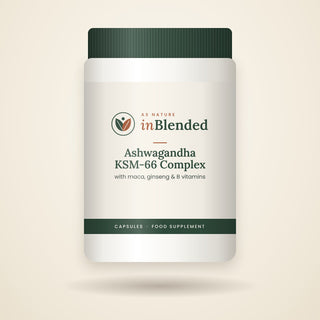
Ashwagandha KSM-66 Complex combines 400mg of KSM-66 ashwagandha root per capsule with other roots and botanicals, reishi and cordyceps mushrooms, and vitamins B3, B5, B6 and B12. The full amounts are shown in the table above.
The following explains what is known about each ingredient group. Research on an individual ingredient does not show that this combination has the same effect.
The Other Botanicals and Mushrooms
Maca. Maca (Lepidium meyenii) is a root from the Andes, traditionally eaten as a food. Small studies have looked at sexual wellbeing, mood and energy, but the research is limited and does not establish it as a treatment for low libido, fertility problems or fatigue.
Panax ginseng. Panax (Asian or Korean) ginseng is a different plant from Siberian ginseng and from ashwagandha, which is sometimes called "Indian ginseng". Research has explored fatigue, cognition and metabolic outcomes, but findings are mixed and depend on the preparation. Ginseng can cause sleeplessness, may affect blood sugar and blood clotting, and can interact with medicines, including some anticoagulants and diabetes treatments.
Schisandra. Schisandra chinensis is a berry-bearing plant used in traditional East Asian practice. Its lignans have been studied in laboratory and early human research, but there is not enough robust evidence to claim that the 25mg in this blend improves stress resilience, liver function or mental performance. Schisandra can affect the enzymes that break down some medicines, and human studies have shown it changing blood levels of drugs such as tacrolimus.
Gotu kola. Gotu kola (Centella asiatica) is a traditional botanical that has been investigated for circulation, skin and cognitive effects. Human evidence for oral supplements remains limited. Rare cases of liver injury have been reported, so people with liver conditions should be particularly cautious with multi-herb products.
Liquorice extract. The blend contains 100mg of deglycyrrhizinated liquorice (DGL). Ordinary liquorice contains glycyrrhizin, which in large amounts over time can raise blood pressure and lower potassium; DGL is processed to remove most of it. That reduces, but does not remove, the need for care, and DGL should not be assumed to treat any particular digestive complaint.
Turmeric. Turmeric contains curcuminoids, including curcumin. Human studies mostly use concentrated curcumin extracts, so their results cannot be applied to the 5mg of turmeric root powder in this blend. Turmeric supplements can cause stomach upset, and rare liver injury has been reported with some concentrated products.
Black pepper. Black pepper contains piperine, which can influence the absorption and metabolism of some substances, including some medicines. It is often combined with turmeric in supplements.
Reishi mushroom. Reishi (Ganoderma lucidum) contains polysaccharides and triterpenes that have been investigated in laboratory and clinical research. Evidence for meaningful benefits in healthy people remains insufficient. Reishi may increase bleeding risk and lower blood pressure or blood sugar, and has rarely been linked to liver injury, so care is needed with blood thinners, blood-pressure and diabetes medicines.
Cordyceps mushroom. Cordyceps refers to a group of fungi used in traditional practice and marketed for energy and exercise performance. Human studies are limited and use different species and preparations, so no stamina or energy benefit should be assumed from this blend.
The B Vitamins: Established Nutrient Functions
Each capsule provides vitamins B3, B5, B6 and B12 at levels above 15% of the Nutrient Reference Value, which is the amount needed for these authorised functions to apply.
Vitamin B3 (niacin). Niacin contributes to normal energy-yielding metabolism, normal functioning of the nervous system and normal psychological function. The product uses nicotinamide, a form of B3 that is much less likely than nicotinic acid to cause flushing.
Vitamin B5 (pantothenic acid). Pantothenic acid contributes to normal energy-yielding metabolism, normal mental performance and the synthesis and metabolism of steroid hormones, vitamin D and some neurotransmitters.
Vitamin B6. Vitamin B6 contributes to normal psychological function, normal functioning of the nervous system, normal energy-yielding metabolism, reduction of tiredness and fatigue, and regulation of hormonal activity. Too much B6 over a long period can cause nerve damage (tingling or numbness in the hands and feet). The European Food Safety Authority set an adult safe upper limit of 12mg a day from all sources in 2023. Three capsules provide 6mg, but count any other supplements containing B6.
Vitamin B12. Vitamin B12 contributes to normal psychological function, normal functioning of the nervous system, normal energy-yielding metabolism and reduction of tiredness and fatigue. It is naturally found in foods such as meat, fish, milk, cheese and eggs, as well as fortified foods. People following a vegan diet need a reliable fortified or supplement source.
These are recognised nutrient functions, not proof that taking extra B vitamins improves concentration, mood or energy in someone who already gets enough.
Safety: Important Points Before Taking Ashwagandha
Ashwagandha is not suitable for everyone. The NIH and the US National Center for Complementary and Integrative Health highlight several precautions.
- Pregnancy and breastfeeding: Avoid ashwagandha during pregnancy and do not use it while breastfeeding unless specifically advised by a qualified healthcare professional.
- Thyroid conditions and thyroid medicines: Ashwagandha may affect thyroid hormone levels and may interact with thyroid medication.
- Liver health: Rare cases of liver injury have been linked to ashwagandha supplements. Stop taking it and seek medical advice if symptoms such as yellowing of the skin or eyes, dark urine, unusual itching or persistent nausea develop.
- Medicines: Potential interactions include medicines for diabetes or high blood pressure, sedatives, anticonvulsants, immunosuppressants and thyroid hormone medicines. Ginseng, reishi, schisandra and black pepper add further interaction considerations, so anyone on regular medication, especially blood thinners, should ask a pharmacist to check the full ingredient list.
- Autoimmune conditions: People with autoimmune disorders should seek medical advice before use, as ashwagandha may influence immune activity.
- Bleeding disorders: Ginseng and reishi may affect blood clotting.
- Hormone-sensitive prostate cancer: Ashwagandha may affect testosterone levels and may not be appropriate.
- Surgery: It is prudent to discuss use with the surgical team and follow their advice about stopping supplements before an operation.
- Side effects: Stomach upset, loose stools, nausea and drowsiness have been reported. Ginseng can cause sleeplessness in some people.
Short-term trials have generally followed participants for up to around three months. Long-term safety over many months or years has not been established. Do not assume that a product is suitable for continuous use simply because it is natural.
Is This Product the Same as the Ashwagandha Used in Clinical Trials?
Partly. It uses KSM-66 root extract, one of the extracts used in published research, at 400mg per capsule. Taken at 1 to 3 capsules a day, that is 400mg to 1,200mg, a range that overlaps the 600mg a day used in several stress and sleep trials.
However, the trials tested ashwagandha on its own. This complex adds other herbs, mushrooms and vitamins, and the combination as a whole has not been tested in a clinical trial. The trial results show what the extract did in those studies, not what this product will do for any individual.
Is Ashwagandha KSM-66 Complex Worth Considering?
Ashwagandha is an interesting botanical with a growing, though still limited, human evidence base for perceived stress and some aspects of sleep. The strongest findings relate to specific standardised extracts and short-term studies, not every product that contains the herb.
The B vitamins in this formula are present at levels that support their authorised roles in normal energy metabolism, psychological function and the nervous system. The additional botanicals and mushrooms have varying levels of research, much of it preliminary or based on preparations that may differ from those in this capsule.
At As Nature inBlended, we believe a supplement should be judged by its actual formulation, evidence and suitability, not by the number of ingredients or the strength of its marketing language.
The Takeaway
Ashwagandha KSM-66 has been studied for stress and sleep, with modest, encouraging results from trials that are generally small and short. This complex provides 400mg of KSM-66 per capsule, alongside maca, ginseng, schisandra, gotu kola, DGL liquorice, turmeric, black pepper, reishi, cordyceps and vitamins B3, B5, B6 and B12, which contribute to normal energy metabolism and psychological function.
It is not suitable during pregnancy or breastfeeding. Anyone taking medication, particularly blood thinners, thyroid, diabetes or blood-pressure medicines, sedatives or immunosuppressants, or anyone with thyroid, liver, autoimmune or bleeding conditions, should seek professional advice before use.
References and Further Reading
- US National Institutes of Health, Office of Dietary Supplements. Ashwagandha: Is it helpful for stress, anxiety, or sleep? https://ods.od.nih.gov/factsheets/ashwagandha-healthprofessional/
- US National Center for Complementary and Integrative Health. Ashwagandha: Usefulness and Safety. https://www.nccih.nih.gov/health/ashwagandha
- Chandrasekhar K, Kapoor J, Anishetty S (2012). A prospective, randomized double-blind, placebo-controlled study of safety and efficacy of a high-concentration full-spectrum extract of ashwagandha root in reducing stress and anxiety in adults. Indian Journal of Psychological Medicine, 34(3), 255–262. https://doi.org/10.4103/0253-7176.106022
- Akhgarjand C et al. (2022). Does ashwagandha supplementation have a beneficial effect on the management of anxiety and stress? A systematic review and meta-analysis of randomized controlled trials. Phytotherapy Research, 36(11), 4115–4124. https://doi.org/10.1002/ptr.7598
- Cheah KL et al. (2021). Effect of ashwagandha (Withania somnifera) extract on sleep: a systematic review and meta-analysis. PLOS ONE, 16(9), e0257843. https://doi.org/10.1371/journal.pone.0257843
- National Library of Medicine, LiverTox. Ashwagandha. https://www.ncbi.nlm.nih.gov/books/NBK548536/
- NCCIH. Asian Ginseng: Usefulness and Safety. https://www.nccih.nih.gov/health/asian-ginseng
- NCCIH. Turmeric: Usefulness and Safety. https://www.nccih.nih.gov/health/turmeric
- EFSA (2023). Scientific opinion on the tolerable upper intake level for vitamin B6. EFSA Journal, 21(5), 8006. https://doi.org/10.2903/j.efsa.2023.8006
- European Commission, Regulation (EU) No 432/2012 – permitted health claims made on foods. https://eur-lex.europa.eu/eli/reg/2012/432/oj/eng
- NHS. B vitamins and folic acid. https://www.nhs.uk/conditions/vitamins-and-minerals/vitamin-b/
Related guides
- Organic Mushroom Complex
- Turmeric Tea: Benefits, Evidence, How to Make It and Safety
- Black Pepper Tea: Benefits, Evidence, How to Make It and Safety
In our shop: Ashwagandha KSM-66 Complex
This article is for general information and education only. It is not medical advice and is not intended to diagnose, treat, cure or prevent any disease. Food supplements should not be used as a substitute for a varied, balanced diet and a healthy lifestyle. Do not exceed the recommended daily intake. If you are pregnant, breastfeeding, taking medication, under medical supervision or have a health condition, speak to your GP or pharmacist before use. Keep out of the reach of children.