As Nature inBlended®

Vitamin D3 3000 IU & K2 MK-7: Benefits, Dosage and Safety
Share
Vitamin D and vitamin K are both essential nutrients involved in normal bone health, but they have different roles in the body. Vitamin D helps the body absorb calcium and maintain normal calcium levels. Vitamin K is needed for normal blood clotting and contributes to the maintenance of normal bones.
Combining the two in a supplement is popular, particularly in products aimed at bone health. Taking both nutrients together has not been proven to prevent fractures or osteoporosis in everyone, and a higher vitamin D dose is not automatically better.
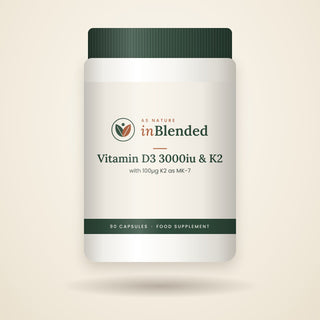
The stated amounts are 3,000 IU of vitamin D3 and 100 micrograms of vitamin K2 (menaquinone-7, or MK-7) per capsule. Vitamin D3 is also known as cholecalciferol. It contains the K2 form as MK-7. Check the current product packaging for the complete excipient list, directions and warnings, as formulations and labelling can change.
What does vitamin D3 do?
Vitamin D helps regulate the amount of calcium and phosphate in the body. These minerals are needed for normal bone formation and maintenance. Vitamin D also contributes to:
- The normal absorption and utilisation of calcium and phosphorus;
- The maintenance of normal bones and teeth;
- The maintenance of normal muscle function;
- The normal function of the immune system.
Vitamin D is sometimes called the sunshine vitamin because the body can produce it in the skin when exposed to ultraviolet B (UVB) radiation. In the UK, sunlight is generally not strong enough for reliable vitamin D production during the autumn and winter months.
Vitamin D3 (cholecalciferol) is one of the forms used in supplements. Vitamin D2 (ergocalciferol) is another. Both can raise vitamin D levels, although D3 is commonly used in supplements.
What does vitamin K2 MK-7 do?
Vitamin K is a group of fat-soluble nutrients. Vitamin K1 (phylloquinone) is found mainly in leafy green vegetables, while vitamin K2 refers to a group of menaquinones found in some fermented foods and animal-derived foods.
MK-7 is one form of vitamin K2. Vitamin K is required for the normal activation of proteins involved in blood clotting and bone metabolism. An authorised nutrition claim states that vitamin K contributes to the maintenance of normal bones.
Vitamin K-dependent proteins include osteocalcin, which is involved in bone mineralisation, and matrix Gla protein, which has a role in regulating mineralisation in soft tissues. This biological role has led to interest in whether K2 supplements can improve bone or cardiovascular outcomes. However, a plausible mechanism does not by itself prove a clinical benefit. Research into K2 supplements and bone density or fracture prevention has produced mixed results, and it is not established that taking K2 alongside vitamin D prevents fractures or arterial calcification.
Why are vitamin D and K2 combined?
Vitamin D supports calcium absorption and normal calcium levels. Vitamin K is involved in the activation of certain proteins that use calcium in tissues, including bone. These complementary roles provide a scientific rationale for studying the nutrients together.
However, it is too strong to say that vitamin K2 is required to “direct” all calcium into bones or that it prevents calcium from entering arteries. Those claims go beyond what has been established in clinical research. There is not enough evidence to recommend a D3-and-K2 combination as a treatment for osteoporosis, heart disease or vascular calcification.
The most reliable foundations for bone health remain adequate nutrition, appropriate weight-bearing and muscle-strengthening activity, not smoking, limiting alcohol and addressing medical risk factors with a healthcare professional.
How much vitamin D is in this product?
One capsule provides 3,000 IU of vitamin D3, equivalent to 75 micrograms (µg). This is a relatively high daily supplement amount compared with the UK public-health recommendation of 10 µg (400 IU) per day for most people who choose to supplement.
The NHS advises that adults and children aged 11 and over should not take more than 100 µg (4,000 IU) of vitamin D per day unless a clinician has advised otherwise. The 75 µg in one capsule is below that adult upper limit, but it leaves only 25 µg before reaching it, before counting other supplements or fortified products. Some people need lower amounts because of medical conditions or medicines.
This product should not be assumed to be suitable as a routine supplement for everyone. If you already take a multivitamin, a separate vitamin D product, cod liver oil or another supplement containing vitamin D, add the amounts together. Do not take multiple vitamin D products without checking the total.
The NHS public-health advice for most adults is to consider 10 µg daily during autumn and winter, with year-round supplementation recommended for some people at increased risk of deficiency. A 75 µg supplement is not the standard public-health dose. Higher amounts may sometimes be prescribed or recommended for a diagnosed deficiency, but that should be based on clinical advice.
Who may need vitamin D?
People can be at greater risk of low vitamin D if they:
- Spend little time outdoors or are housebound;
- Cover most of their skin when outdoors;
- Have darker skin;
- Are older or live in residential care;
- Have conditions that affect absorption of fat-soluble vitamins.
The NHS recommends that adults and children over four consider a daily supplement containing 10 µg during autumn and winter. People at increased risk may be advised to take 10 µg throughout the year. Babies and younger children have separate guidance and need age-appropriate preparations.
Vitamin D can also be obtained from oily fish such as salmon, sardines and mackerel, egg yolks, red meat and foods fortified with vitamin D. However, relatively few foods naturally contain substantial amounts.
What about vitamin K in the diet?
Vitamin K1 is found in green leafy vegetables such as spinach, kale, broccoli and cabbage. Vegetable oils and some other foods also provide vitamin K. Vitamin K2 occurs in foods such as certain fermented products, including natto, and in smaller amounts in some animal-derived foods.
Most people can obtain the vitamin K they need from a varied diet. The product provides 100 µg of K2 MK-7 per capsule, but supplementation is not automatically necessary simply because vitamin D is being taken.
Can vitamin D3 be harmful?
Vitamin D is fat-soluble and can accumulate in the body. Excessive intake from supplements over time can cause hypercalcaemia, meaning too much calcium in the blood. This can lead to nausea, vomiting, weakness, confusion, excessive thirst and urination, kidney stones and, in severe cases, kidney or heart complications.
The NHS upper limit for adults is 100 µg (4,000 IU) daily from all sources, unless a clinician has advised a different dose. This is a safety ceiling, not a target intake. People with certain medical conditions may need to avoid high-dose vitamin D or have their calcium and vitamin D levels monitored.
Seek medical advice before taking a 3,000 IU supplement if you have:
- High calcium levels or a history of kidney stones;
- Kidney disease or reduced kidney function;
- Sarcoidosis or certain other granulomatous conditions;
- Hyperparathyroidism;
- A condition that affects vitamin D metabolism or calcium balance.
Do not use a high-dose supplement as a substitute for diagnosis or treatment of vitamin D deficiency.
Important medicine interactions
Vitamin D supplements can interact with some medicines. For example, thiazide diuretics can increase the risk of high calcium levels when combined with vitamin D, particularly in people with impaired kidney function or other risk factors. Orlistat can reduce vitamin D absorption, while some steroids can affect vitamin D status. Ask a pharmacist or doctor to check your medicines if you are unsure.
Vitamin K has a particularly important interaction with warfarin and other vitamin K antagonists. A sudden change in vitamin K intake can affect anticoagulation control. People taking warfarin should not start, stop or change a vitamin K supplement without speaking to their anticoagulation clinic or prescriber. The aim is a consistent vitamin K intake, with any changes managed by the clinical team.
Do not assume that MK-7 is safe with warfarin simply because it is a supplement or because the dose is 100 µg.
Does vitamin D3 and K2 improve bone strength?
Vitamin D is essential for normal bone health, and correcting vitamin D deficiency is important. Vitamin K also has a recognised role in normal bone physiology. These facts do not mean that taking more of either nutrient will necessarily make bones stronger in someone who already has adequate intake.
Research into vitamin K2 and bone outcomes is ongoing, with differences in study populations, doses and formulations. Evidence is not strong enough to claim that this particular combination prevents osteoporosis or fractures.
People with osteoporosis, previous fragility fractures or a high risk of falls should discuss proven assessment and treatment options with their GP. Supplements may be appropriate where dietary intake is inadequate or deficiency is identified, but they are not a replacement for evidence-based care.
How should a vitamin D supplement be taken?
Vitamin D is fat-soluble, so taking it with a meal containing some fat may help absorption. Follow the product's current label directions and do not exceed the stated daily serving.
Keep a note of vitamin D in all supplements you use, including multivitamins and fish liver oils. If a healthcare professional has prescribed a different dose for a deficiency, follow that advice and do not add this product on top unless they have approved it.
The As Nature inBlended perspective
At As Nature inBlended, we believe supplements should be used thoughtfully as part of a varied, balanced diet and healthy lifestyle. Vitamin D and vitamin K have established roles in normal bone function, but more is not always better. The 3,000 IU vitamin D amount in this product is higher than the routine 10 µg public-health supplement recommendation for most UK adults, so it is important to consider total intake and personal circumstances.
Anyone taking warfarin, living with kidney or calcium-related conditions, or already using vitamin D supplements should seek professional advice before adding a D3-and-K2 product.
Food supplements should not be used as a substitute for a varied, balanced diet and a healthy lifestyle. Do not exceed the recommended daily dose. Keep supplements out of the reach of children.
Sources and further reading
- As Nature inBlended – Vitamin D3 3000 IU and Vitamin K2 100µg MK7 product listing: https://www.asnatureinblended.com/collections/vitamins
- NHS – Vitamin D: https://www.nhs.uk/conditions/vitamins-and-minerals/vitamin-d/
- NHS – Vitamin K: https://www.nhs.uk/conditions/vitamins-and-minerals/vitamin-k/
- NHS – About colecalciferol: https://www.nhs.uk/medicines/colecalciferol/about-colecalciferol/
- NIH Office of Dietary Supplements – Vitamin D: https://ods.od.nih.gov/factsheets/VitaminD-HealthProfessional/
- NIH Office of Dietary Supplements – Vitamin K: https://ods.od.nih.gov/factsheets/VitaminK-HealthProfessional/
Related guides
- Vitamin K2 MK-7 100µg: What It Does, Food Sources and What the Evidence Says
- Green Tea — Catechins, Antioxidants and What the Evidence Really Says
In our shop: Vitamin D3 3000 IU
This article is for general information and education only. It is not medical advice and is not intended to diagnose, treat, cure or prevent any disease. Food supplements should not be used as a substitute for a varied, balanced diet and a healthy lifestyle. Do not exceed the recommended daily intake. If you are pregnant, breastfeeding, taking medication, under medical supervision or have a health condition, speak to your GP or pharmacist before use. Keep out of the reach of children.